Packing a Day Pack Without Dead Weight
The last hour of the valley loop was slower than the first, and the pack was the reason. At the granite slab we emptied three kits onto the stone. Most of what came out had not been touched since the kiosk.
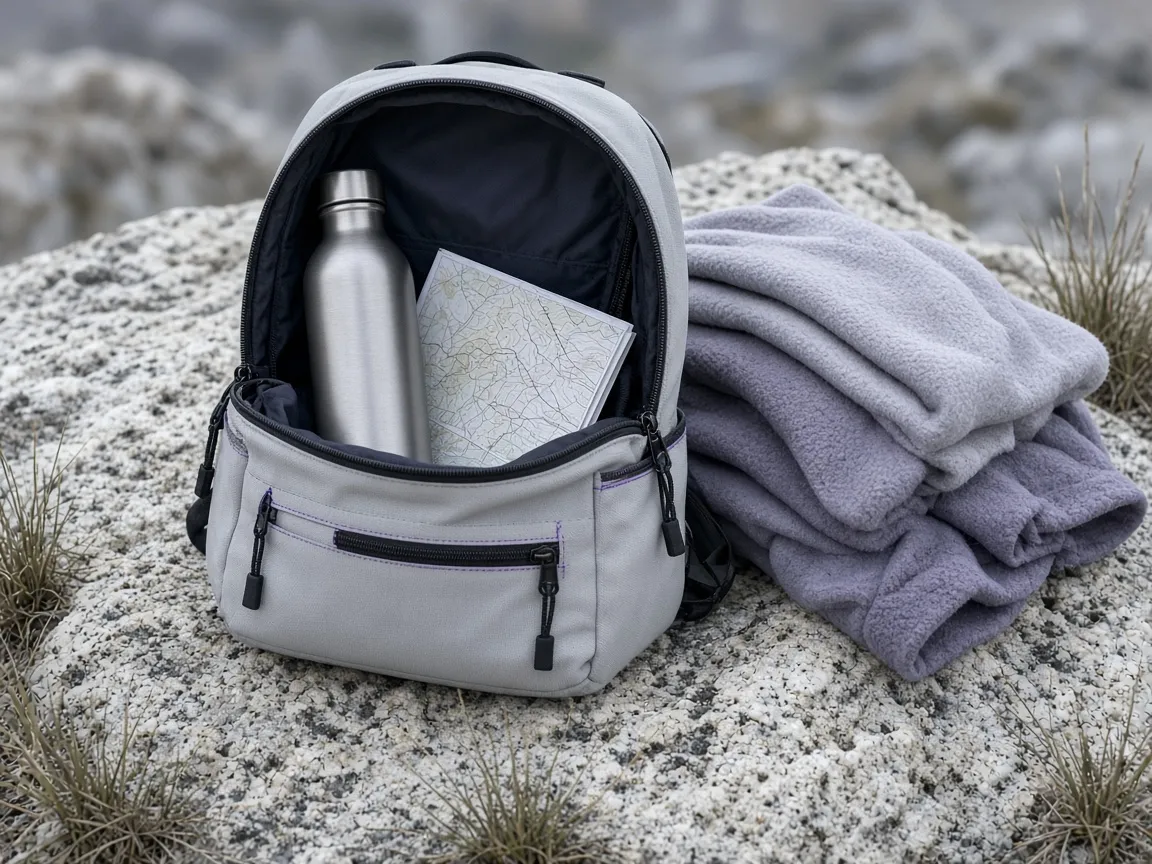
The pile that never left the pocket
We had packed as if the walk might become a different walk: extra food “in case,” a second mid-layer, a small toolkit, a spare notebook, a charger that needed a socket we would not meet. None of it was foolish in a list. All of it was dead once the hours were counted. Dead weight is not the object you might need one day. It is the object that never earned its strap on this day.
What actually left the pack
I am not arguing for a heroic empty bag. I am arguing for an honest one. On that loop, four things did work. They are not a shopping list. They are a test you can run after any outing: did this leave the pocket?
- Water. Not a second bottle that stayed sealed as a talisman. The one we drank from, refilled where we had planned to, and could still lift without a grunt at the last rise.
- A light. Not because we meant to walk after dark, but because a late junction and a slower return are how days actually end. A light you can find with one hand is the point. A light buried under unused layers is a rumor.
- One layer that matched the forecast, not the closet. The extra fleece never left the bag. The shell came out once, at the windy bench, and went back. That is use. The third layer was autobiography.
- A way to read the map with no signal. Paper, a saved image, a note on the junction times — anything that does not require a tower. Two of us had apps that became grey squares in the trees. The folded map still had a crease at the right fork.
Everything else had a story attached to it. Stories are heavy:
- The extra snacks that returned home in the same wrapper.
- The spare socks for a walk that never crossed a wet trough.
- The battery brick that never met a dying phone because the phone was already a paperweight.
- The “just in case” booklet that lived under the water bottle and never saw daylight.
If it did not leave the pocket, it did not belong in the pocket. Write that down before the next kiosk, while your shoulders still remember the last hour.
How to pack for the hours you actually have
The useful ritual is ugly and short. Lay the kit on a table. Name the hours you intend to be out. Pick objects against those hours, not against a version of yourself who might get lost for two extra days. If you cannot say when an item would be used, it stays home.
Do the same emptying after the walk, while the memory is mean. Praise is a poor auditor. Tired shoulders are a good one. If three people dump their packs and the same objects sit unused every time, that is data. Keep the data. Do not keep the objects out of loyalty.
There is a limit. A first-aid wrap that never opens is not dead weight in the same way a third sandwich is. One is for a rare, ugly minute. The other is comfort posing as care.
The last hour is where dead weight shows. Grades that felt polite before lunch become a tax after it. People who packed “just in case” start talking less. That silence is not mystery. It is mass. A lighter bag does not make anyone faster by magic. It only stops you from spending the return paying for a morning of imaginary emergencies.